What Makes a HEPA Filter Air Purifier Worth It? The Science Behind Cleaner Air
When you think about clean air at home, you might picture open windows and indoor plants, but true air purification goes far beyond that. The invisible particles floating around dust, pollen, pet dander, smoke, and even bacteria can affect your health more than you realise. That’s where HEPA filter air purifiers come in, setting a higher benchmark for indoor air quality.
Understanding the Science of HEPA Filtration
HEPA stands for High Efficiency Particulate Air. These filters are specially designed to capture extremely small particles, up to 0.1 microns in size, with 99.97% efficiency. Unlike regular air filters, which mostly capture larger dust particles, HEPA filters use a dense mesh of fine glass fibres arranged in a complex pattern. When air passes through, three mechanisms come into play:
- Interception: Particles travelling in the air stream stick to the fibres when they pass close enough.
- Impaction: Larger particles collide directly with the fibres and get trapped.
- Diffusion: Ultrafine particles, such as smoke or viruses, move erratically (Brownian motion) and are caught by the filter fibres.
The result? Air that’s significantly cleaner, fresher, and healthier to breathe, especially in homes located near traffic-heavy areas or regions prone to dust and pollution.
Why a HEPA Filter Outperforms a Regular Filter
A standard filter might catch visible dust, but it often lets microscopic pollutants, such as pollen, mould spores, or PM2.5 particles, pass through. These are the same particles that cause sneezing, eye irritation, and respiratory discomfort.
Think of it like this: if you compare a regular air filter to a fishing net, it’s great for catching big fish but lets the smaller ones slip through. A HEPA filter, on the other hand, works more like a fine sieve, capable of catching even the tiniest particles that ordinary filters miss. That precision makes HEPA filters especially valuable for people with asthma, allergies, or sensitivities to dust and odours.
Real-World Example of How HEPA Makes a Difference
Imagine two homes in the same city, one uses a basic air filter, while the other uses a HEPA-equipped air purifier for home. After a few weeks, the first home might notice dust reappearing quickly, with allergy symptoms persisting. The second home, however, experiences noticeably cleaner air, less sneezing, and minimal dust accumulation. That’s the measurable difference HEPA filtration can make.
Eureka Forbes HEPA Filtration Technology
Eureka Forbes integrates advanced HEPA filter technology into its range of air purifiers to ensure superior air purification. These filters are often paired with activated carbon layers and plasma purification to neutralise odours, gases, and airborne pathogens—offering complete multi-layered protection.
Two excellent examples are:
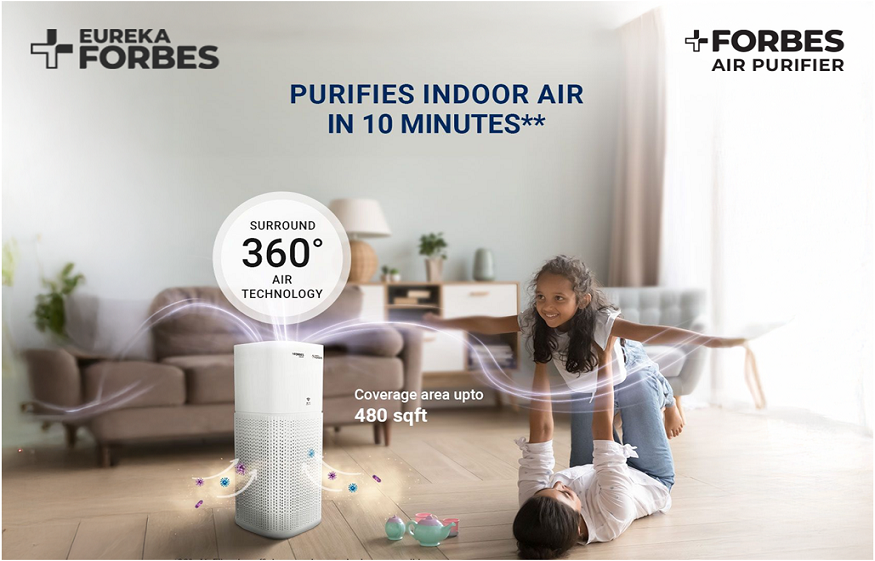
- Forbes Smart 355 Surround 360° Air Purifier – Ideal for medium-sized rooms, featuring a True H13 HEPA filter that removes up to 99.97% of airborne particles. With smart sensors and a real-time PM 2.5 display, it automatically adjusts to maintain healthy indoor air.
- Forbes Smart 500 Surround 360° Air Purifier – Designed for larger spaces, this purifier combines HEPA and plasma filtration for enhanced coverage and faster purification. It’s WiFi-enabled, allowing you to monitor and control air quality effortlessly.
Why Investing in a HEPA Air Purifier Is Worth It
A HEPA filter is a commitment to better health. Clean air supports better sleep, reduces allergy symptoms, and can even enhance concentration and mood. When combined with proper ventilation and regular maintenance, a HEPA-based air purifier can transform your home into a sanctuary of clean, breathable air.
Whether you live in a city apartment or a suburban home, choosing a purifier with a certified HEPA filter ensures that the air you and your family breathe is as pure as it can be.

Avoiding The Car Lockout

6 Interior Designers’ Secrets On How To Revamp Your Home

Sacramento’s Leading Custom Home Builders: Your Dream Home, Your Way
About Author
